The Hidden Vision Link in ADHD and Dyslexia — and What a 2026 Research Review Says About Virtual Reality Therapy
A plain-language look at new evidence, written for parents who want to understand their child and for therapists who want the clinical detail. The centerpiece is a 2026 systematic review; we explain what it examined, what it found, and — just as importantly — what it does not yet prove.
Why vision keeps coming up in ADHD and dyslexia
When a child struggles to pay attention or to read, the conversation usually starts and ends with the brain. But a growing body of research points to something more mechanical that often rides along with these conditions: the visual system itself. Children with
ADHD and dyslexia have higher rates of visual difficulties such as convergence insufficiency (trouble getting the eyes to work together up close) and other binocular problems. When the eyes do not team well, sustained reading and focused attention become genuinely harder — not because the child is not trying, but because the visual input is unstable.
This overlap is easy to miss. A child who loses their place while reading, avoids near work, or seems inattentive may be showing a visual-processing problem, an attention problem, or both at once. That is the backdrop for a 2026 systematic review that asked a specific, practical question: can virtual reality therapy help.
What this means for you as a parent
Reading is not only a brain job. It is also an eye job. Both eyes have to point at the same word at the same time and stay there. For some kids that takes real effort, and their eyes drift or get tired.
One common version of this has a long name, convergence insufficiency. It means the eyes have trouble teaming up on things that are close, like a book or a worksheet.
Kids with ADHD and dyslexia have this kind of eye trouble more often than other kids do. So a child who loses their place, skips lines, or gives up on reading may not be careless or lazy. The words may not be holding still for them.
What the 2026 review examined
According to a systematic review published in
Neuroscience & Biobehavioral Reviews, researchers set out to evaluate how well virtual reality therapy (VRT) treats visual dysfunction in children with ADHD and/or dyslexia (Chung et al., 2026;
DOI). They analyzed 20 studies published between 2015 and 2025, drawing together evidence on visual acuity, binocular function, visual attention, and reading.
For therapists, the design detail matters: this is a systematic review synthesizing a decade of work, not a single trial. That breadth is a strength for spotting consistent signals, but the authors are candid that the underlying studies vary widely in method, which limits how firmly the results can be pooled.
What this means for you as a parent
The scientists did not run a new test on kids. They gathered 20 studies done between 2015 and 2025 and looked at them all together. That is called a systematic review.
Reviews like this are good at spotting patterns that one small study would miss. But they have a weak spot too. Those 20 studies were not all run the same way, so the results do not stack up neatly. The authors say so themselves.
Keep that in mind as you read the next part. The findings are worth knowing. They are just not the final word.
What the researchers found
Across the included studies, virtual reality therapy produced measurable gains:
- Improvements in
visual acuity of roughly 0.89 to 1.32 lines on an eye chart, along with better stereoacuity in amblyopia.
- In children with ADHD,
reductions in attention errors — fewer omission and commission errors on attention testing.
- In dyslexia, gains in
reading speed and
visual perception, with a large effect on visual perception.
- For binocular dysfunction, VRT gains were
comparable to conventional patching, the long-standing standard approach.
The authors summarize the effects as moderate to large. A recurring theme is engagement: the gamified, immersive design of VR appears to improve how consistently children stick with therapy — a real-world advantage, since adherence is where many vision and attention programs quietly fail.
The practical translation for parents: in the studies reviewed, a game-like vision therapy helped some children see more clearly, sustain attention a little better, and read a little faster. That is promising, but it is early evidence, not a guarantee for any individual child.
What this means for you as a parent
Here is what those findings mean in everyday terms.
Kids could read about one more line down on the eye chart, the kind the eye doctor asks you to read out loud. That is a small change, but a real one.
The phrase omission and commission errors just means two kinds of mistakes on an attention test. Missing something you should have caught, and reacting to something you should have skipped. Kids made fewer of both.
Kids with dyslexia read a little faster and got better at making sense of what they saw. And for eye teaming problems, the headset worked about as well as patching, which is the older method where one eye is covered so the weaker eye has to do the work.
The most useful finding may be the simplest one. Kids actually did the exercises, because it felt like a game. A lot of vision programs fail because kids quit, not because the exercises are bad.
What virtual reality therapy actually is
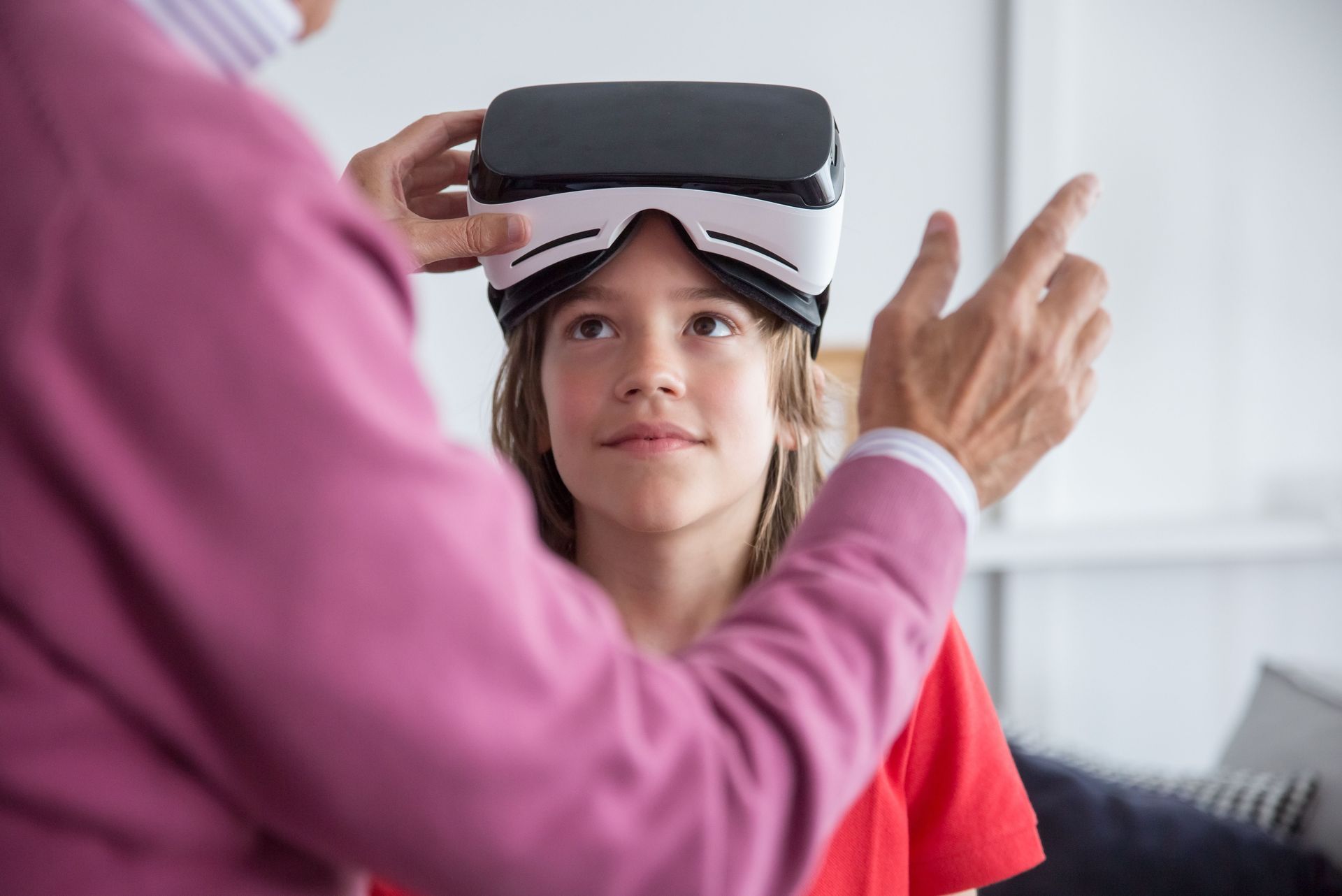
In this context, VRT is not entertainment. It is a set of structured visual exercises delivered through a headset or immersive screen, designed to train the eyes to converge, track, and work as a team, often while the child completes a game-like task. Because it feels like play, children tend to complete more repetitions than they would with traditional worksheet-style exercises. This is the same principle that drives play-based
occupational therapy: motivation and repetition are what build skill.
What this means for parents
If your child has
ADHD or ADD, or dyslexia, it is reasonable to ask whether a vision component is part of the picture — especially if reading is a specific struggle. A few grounded takeaways:
- Vision problems and attention problems can look alike and can coexist. A thorough evaluation helps tease them apart.
- Virtual reality vision therapy is an emerging option with encouraging early results, but it is not yet a settled standard of care. Treat confident marketing claims with healthy skepticism.
- Established supports — vision assessment by an eye-care professional, reading intervention, and therapy that builds
fine motor and visual-motor skills — remain the foundation.
What this means for therapists and clinicians
For occupational therapists and other pediatric clinicians, the review is useful less as a directive and more as a signal. The engagement advantage is the standout finding: VR's adherence benefit addresses a genuine clinical pain point, and effect sizes comparable to patching for binocular dysfunction are worth watching. VRT is best framed as a potential complement to skilled intervention rather than a replacement for clinical reasoning, and it slots naturally alongside
sensory integration and visual-motor work already in the toolkit.
Given the heterogeneity the authors flag, clinicians adopting VR tools should track their own outcome measures rather than assume the pooled effect sizes will transfer to their caseload.
What this means for you as a parent
That section was written for therapists, so it uses their work words. Here is the short version.
Nobody is telling therapists to go buy a headset. The review is a heads up, not a rule.
The part therapists care about most is that kids stick with it. A therapy only helps if the child keeps doing it, and this one is fun enough that they do. For eye teaming problems it also held up about as well as patching, which is worth watching.
One thing you can ask about. If your child's clinic starts using VR, they should still measure your own child's progress instead of assuming the group results will apply. That is a fair question to bring up.
The limits of the evidence
A credible resource has to name what the research cannot yet claim, and the authors are clear on this point. The literature is fragmented: most studies examine ADHD or dyslexia in isolation rather than the comorbidity that many real children live with. Study designs are heterogeneous, which constrains firm conclusions. And there is a shortage of large, well-designed randomized controlled trials with long-term follow-up, so we do not yet know how durable these gains are. The honest summary is: promising direction, incomplete proof.
What this means for you as a parent
This is a promising direction, not proof. Here is why, plainly.
Most of the studies looked at ADHD by itself or dyslexia by itself. Plenty of real kids have both at once, and that mix was barely studied.
The 20 studies were also run in different ways, so their results cannot be added up cleanly. There are not enough large, careful studies yet, and almost nobody followed the kids for long afterward. So we do not know whether the gains stick.
What to do with all that: it is fine to be curious about VR vision therapy, and it is also fine to wait. If someone sells it to you as a proven fix for ADHD or dyslexia, that is more than the research actually supports.
Signs of a visual-processing difficulty worth checking
For parents and therapists alike, these are common everyday signs that vision — not just attention — may be part of the story:
- Losing place, skipping lines, or re-reading while reading.
- Avoiding or quickly tiring of near work like reading or worksheets.
- Headaches, eye rubbing, or complaints of blurry or double vision during close tasks.
- Difficulty copying from the board, or unusually effortful handwriting, which can also reflect
executive function and visual-motor demands.
None of these confirms a diagnosis on its own, but together they are a reasonable prompt for a professional evaluation.
Frequently asked questions
Can ADHD and dyslexia cause vision problems?
ADHD and dyslexia do not cause eye disease, but children with these conditions have higher rates of functional vision difficulties like convergence insufficiency, which can make reading and sustained attention harder. Research increasingly treats the visual and attentional pieces as overlapping.
Does virtual reality therapy for ADHD actually work?
A 2026 systematic review found moderate-to-large improvements in visual function, attention, and reading across the studies it reviewed, with strong engagement. However, the authors caution that the evidence is early and mixed, and large long-term trials are still needed.
Should my child see an eye doctor or a therapist first?
Both can play a role. An eye-care professional can assess how the eyes work together, while occupational and reading therapies address the functional impact. A coordinated, multidisciplinary approach usually serves children best.
Is vision therapy a replacement for other ADHD or dyslexia support?
No. Current evidence positions it as a possible complement to established interventions, not a substitute for them.
Where families can turn
Progressive Pediatric Therapy supports children with ADHD, dyslexia, and related learning and developmental differences across Palm Beach County, using evidence-based, play-forward therapy and a multidisciplinary team. If this article raised questions about your child, our therapists are glad to talk through what an evaluation would look like.
Sources & attribution
- Primary study, retrieved from
PubMed: Chung KS, Lee KY, Tang YM, Lai CYY, Do CW, Fong KNK.
Systematic review of virtual reality therapy in the treatment of visual dysfunction in children with ADHD and dyslexia. Neurosci Biobehav Rev. 2026;187:106723.
https://doi.org/10.1016/j.neubiorev.2026.106723
- Background prevalence context: U.S. CDC / National Center for Health Statistics, National Survey of Children's Health (2022) and NCHS Data Brief No. 499 (2024).