A randomized controlled trial published in 2025 in Pediatric Exercise Science tested a question many families ask: if we add treadmill training and balance exercises on top of a child's regular therapy, does it help?
The answer turned out to be more interesting than a simple yes. Walking improved. Balance did not. And the gap between those two results teaches something more useful than a clean win would have.
What the Trial Did
Twenty-two children between the ages of 6 and 12 with spastic cerebral palsy took part. All were classified at Gross Motor Function Classification System levels I through III, meaning they were walkers, with or without a hand-held mobility device.
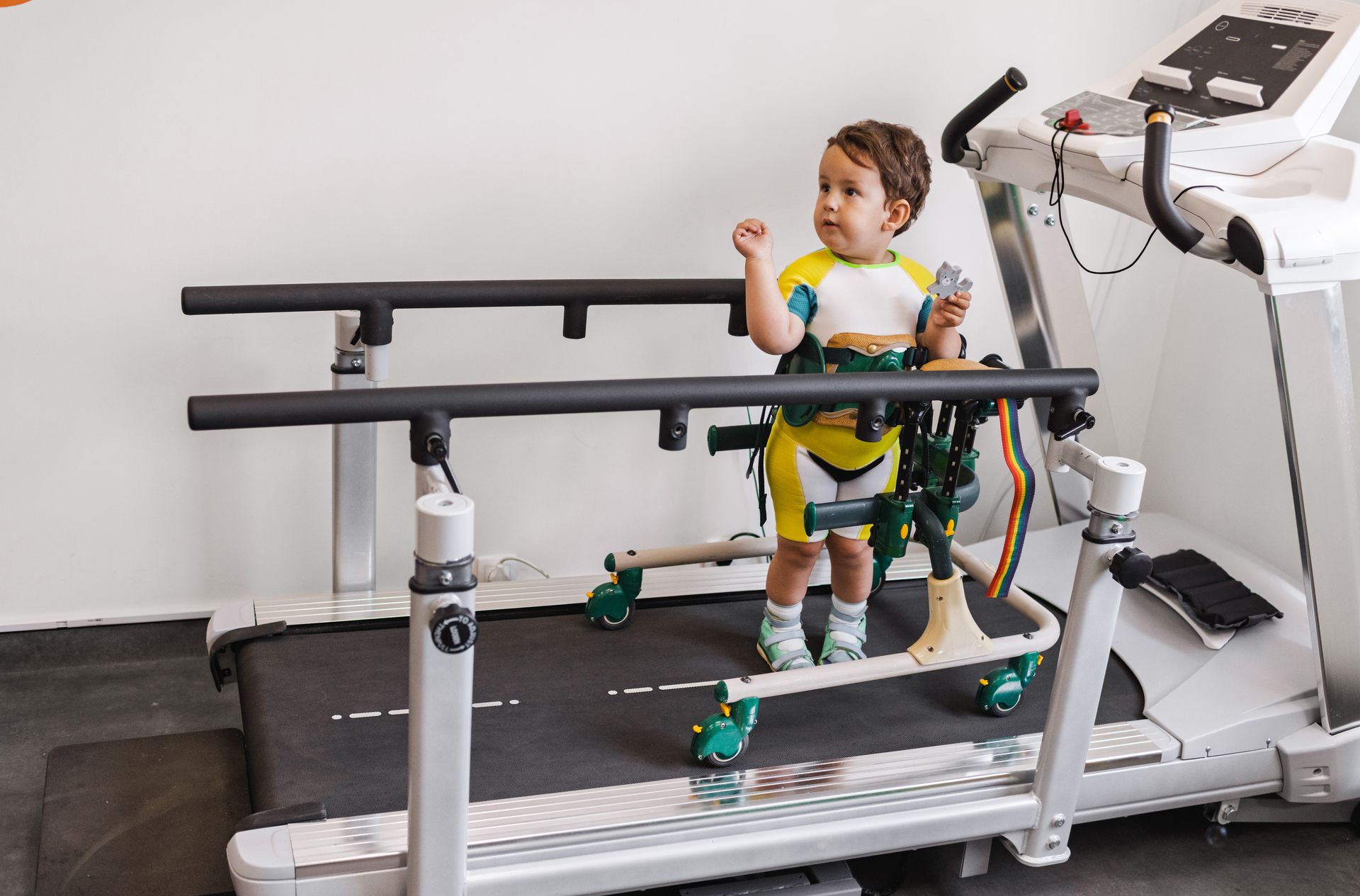
The children were randomly assigned to one of two groups. Both groups received neurodevelopmental treatment across a 12-week period. The intervention group received something extra: treadmill training combined with balance exercises.
That design detail is important. This was not treadmill training versus nothing. It was standard therapy versus standard therapy plus a targeted gait program. Any difference between the groups is attributable to the addition, not to the therapy both groups already had.
The researchers measured walking speed, two dimensions of the Gross Motor Function Measure (dimension D for standing and dimension E for walking, running, and jumping), the Pediatric Balance Scale, a one-minute walk test, and ankle range of motion. Measurements were taken at the start and again at 12 weeks by an assessor who did not know which group each child was in.
What This Means for You as a Parent
Twenty-two kids with cerebral palsy joined this study. They were 6 to 12 years old. All of them could walk. Half of them got their normal therapy. The other half got normal therapy plus treadmill work and balance exercises. This went on for 12 weeks. Then a tester checked how each child did. The tester did not know which group each child was in. That is important. It keeps the results fair and honest.
What Improved
The group that got the extra gait training beat the control group on two measures.
Their
walking speed on a 10-meter walk improved significantly compared with the control group. Their score on
Gross Motor Function Measure dimension E, which covers walking, running, and jumping, improved by an average of 16.8 points more than the control group, with a confidence interval running from 3.9 to 29.7.
Dimension E is scored as a percentage of the maximum possible, so a gain of roughly 17 points is a substantial shift in the skills that dimension captures. The confidence interval is wide, which is expected in a trial this small, but the entire range sits above zero.
The researchers also noted no serious adverse events. Treadmill training with this population, delivered in a supervised setting, was well tolerated.
What This Means for You as a Parent
The kids who did the treadmill work walked faster. They also got better at walking, running, and jumping skills. That is a real gain, not a small one. Nothing bad or unsafe happened during the study. So if a therapist suggests treadmill work for your child, this study supports that idea.
The Real Gap: Nobody Knows the Right Dose Yet
This is the most important limitation in the review, and the authors are direct about it.
The 22 trials used different protocols, different exercises, different session lengths, and different program durations. That variety, which researchers call methodological heterogeneity, makes it possible to say that balance training works while making it very hard to say which balance training works best, or how much of it a child needs.
The authors call for future studies that examine dose-response relationships, meaning the link between how much training a child receives and how much benefit they get. Right now, that guidance does not exist in the published evidence.
That gap does not make the finding weak. It makes clinical judgment essential. A therapist choosing exercises for your child is not following a published formula, because there isn't one. They are drawing on training, assessment, and observation of how your specific child responds.
What This Means for You as a Parent
Every study used a different plan. Some did short sessions. Some did long ones. Some used different exercises. So scientists know balance training works. They do not yet know the perfect amount or the perfect exercises. This is why a good therapist watches your child closely and changes the plan. If someone hands you one worksheet and says this works for everyone, be careful. There is no single right plan yet.
What Didn't Improve, and Why That Is the Real Story
Here is the part that gets left out of most summaries. Beyond walking speed and dimension E, there were
no other significant differences between the groups.
The Pediatric Balance Scale did not show a between-group difference. Neither did ankle range of motion. Neither did dimension D, which measures standing.
That is worth sitting with, because the intervention explicitly included balance exercises. The children did balance work, and their balance scores did not separate from the control group's.
The authors' own conclusion names this directly. The training was focused on gait, and gait is what improved, with little if any change in other outcomes such as balance or range of motion.
This is a principle physical therapists call specificity of training. Bodies get better at what they practice, and the transfer to related-but-different skills is often smaller than we assume. Walking on a treadmill is excellent practice for walking. It turns out to be much weaker practice for standing steady on one foot.
What This Means for You as a Parent
The kids got better at walking. They did not get better at balance. Even though the plan included balance exercises. Here is the simple lesson. Kids get better at the thing they practice most. Walking practice makes walking better. It does not fix everything else at the same time. So if your child needs help with balance AND walking, they may need work on both. One will probably not fix the other on its own. This is a good question to ask your therapist. Which skill are we working on right now, and how will we know it is working?
The Honest Caveat: This Was a Small Trial
Twenty-two children is a small sample. Small trials can detect large effects reasonably well, but they produce wide confidence intervals, and they are poor at detecting smaller effects that may still be real.
That cuts in both directions here. The walking gains are believable because they were large enough to surface despite the sample size. But the absence of a balance effect should be read as "this trial did not find one," not as proof that balance training never helps children with cerebral palsy. A larger 2026 meta-analysis of 22 separate trials found that balance training does improve balance in children with developmental disorders, including cerebral palsy.
Both findings can be true at once. Balance training works when balance training is the focus. In this particular trial, the program was weighted toward gait, and gait is where the gains landed.
What This Means for You as a Parent
Only 22 kids were in this study. That is small. Small studies can miss things. So do not read this as "balance training never works." Other, bigger research shows balance training does help kids. What this study shows is narrower. In this plan, walking got most of the attention, and walking got most of the gains. One study is one piece of the puzzle. Never the whole picture.
How Progressive Pediatric Therapy Approaches Gait and Balance in Cerebral Palsy
At
Progressive Pediatric Therapy, this is exactly why goal setting comes before program building. A child who needs to walk farther without fatiguing and a child who needs to stop falling on uneven ground need different programs, even though both goals live under the heading of mobility.
Our licensed pediatric physical therapists evaluate first, name the specific target, choose interventions that match that target, and reassess on a schedule so a plan that is not producing change gets changed. When a child has multiple goals, we sequence them deliberately rather than assuming one will carry the other.
You can learn more on our
cerebral palsy program page or our page on
balance and walking difficulties.
What This Means for You as a Parent
Walking farther and staying steady are two different goals. They may need two different plans. A good therapist picks a clear target first. Then they check often to see if it is working. If it is not working, they change it. You can ask about this at any visit. Ask what the goal is right now. Ask how progress gets measured. Those are fair questions, and good therapists like them.
When to Seek a Physical Therapy Evaluation
Consider scheduling an evaluation if your child:
- Has a diagnosis of cerebral palsy and has not had a mobility reassessment recently
- Walks noticeably slower than peers or tires quickly when walking
- Has difficulty keeping up on the playground or in the hallway at school
- Falls frequently or avoids uneven surfaces
- Has plateaued in therapy without a change in approach
- Struggles with running, jumping, or stairs
- Uses a walker or other device and may be ready to progress
A Note for Referring Providers and Therapists
The clinically actionable point here is dissociation of outcomes within a combined intervention. Adding treadmill training plus balance exercises to neurodevelopmental treatment yielded between-group gains on 10-meter walk speed and GMFM-E only, with no separation on the Pediatric Balance Scale, GMFM-D, one-minute walk test, or ankle range of motion. Read alongside the 2026 balance training meta-analysis, the reasonable interpretation is that combined programs risk under-dosing the secondary target. If balance is a stated goal, it likely needs its own dedicated volume rather than inclusion as an adjunct to gait work. Note also the sample of 22 and correspondingly wide confidence intervals.
Sources
This article is for general educational purposes and is not a substitute for individualized evaluation by a licensed physical therapist.